Under Oath
OVER THE LINE
TRAVEL ADVISORY
San Diego > Vista: Child Trafficking Network (CTN)
But whoso shall offend one of these little ones which believe in me, it were better for him that a millstone were hanged about his neck, and that he were drowned in the depth of the sea. — Matthew 18:6
Fraud in Child Welfare: Manufacturing ‘Danger’ to Break a Family
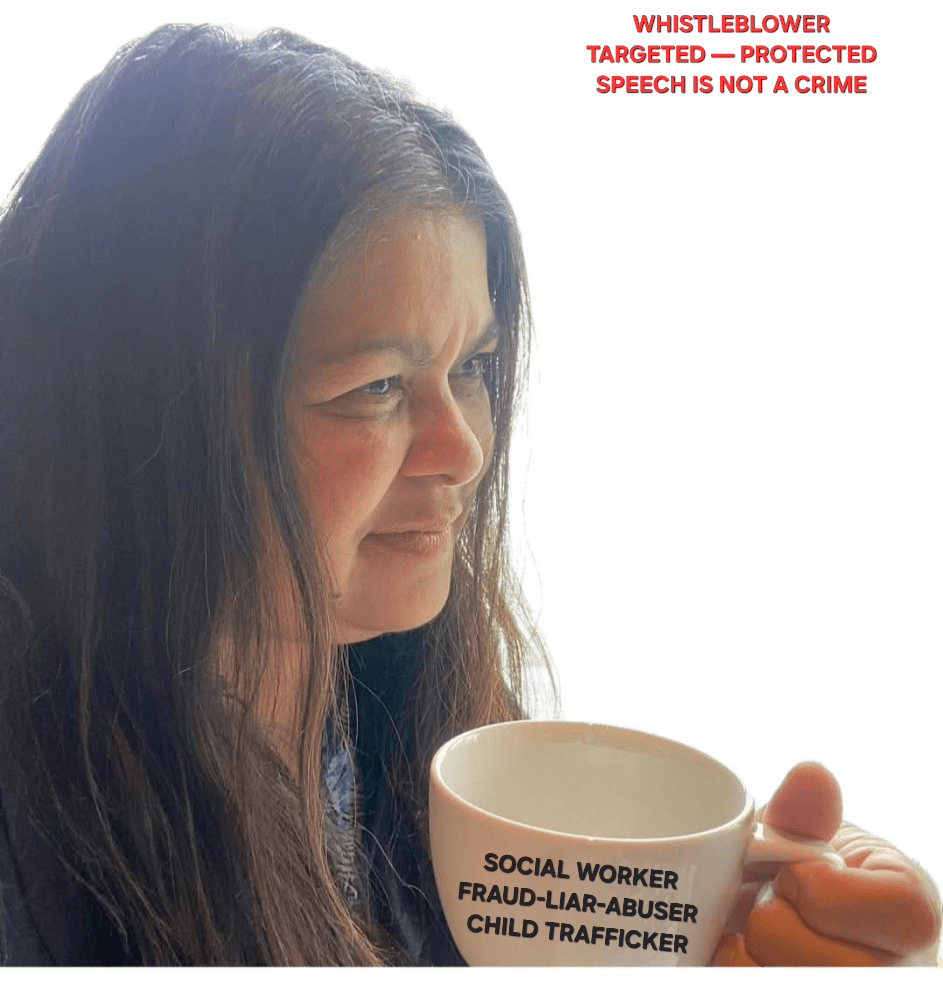
Nicole Montzingo-Avila
UNDER OATH, OVER THE LINE
Revenge with a badge is still revenge—and everyone pays: children, parents, elders… even the dead.
On February 10, Montzingo-Avila bragged she’s been a social worker since 2002 and a supervisor since 2020. Translation: 24 years of getting away with it, and 6 years of rubber-stamping the same behavior under her.
A Social Worker’s Fraud Against Family Bonds
This is not social work. Nicole Montzingo-Avila is engaging in predatory misuse of power—lying on the record, escalating restrictions, and blocking reunification while hiding behind “process” and paperwork. This is bigger than one worker: after the family spoke up publicly about the agency as a whole—about misconduct, retaliation, and what happens behind closed doors—the response became harassment and punishment. When the system gets exposed, it closes ranks, recasts exposure as “harassment,” and then flips that into a “danger” narrative to justify restraining orders, tighter supervision, and deeper isolation. The most serious part is the deliberate, detrimental harm being inflicted on Malaika and Xayah Robinson, two children—ongoing, severe harm the family states is documented—while officials treat their trauma like collateral damage in a campaign to silence and break a family.
They call it “harassment” because that word is useful—it turns a whistleblower into a threat and lets a system of officials and enablers close ranks. But when a family is up against thousands of government employees, lawyers, and insiders with institutional power, public speech is not harassment; it is self-defense and documentation. Blogging is the only tool an ordinary human being has to push back, to preserve the record, to warn the public, and to keep the truth from being buried behind closed doors. If the system wanted silence, it should have chosen accountability; instead it chose retaliation—and now it wants to criminalize the family’s voice for refusing to disappear.
What Happened
The record in this case contains a stark contradiction: written case materials acknowledge a real, observable bond between the children and their paternal grandfather—then, under oath, that same bond is effectively erased with a sweeping “danger” label delivered without a specific, evidence-based justification.
On February 10, in sworn testimony, Nicole Montzingo responded “yes” when asked—directly—whether the paternal grandfather was a danger to his grandchildren. That statement is preserved as a breaking point for credibility because it conflicts with prior written tone and representations in the case file that recognize attachment and relationship.
The Core Fraud
Fraud in a child-welfare context does not require theatrical misconduct; it can be as simple as weaponizing a label (“danger”) to justify restrictions that cannot be justified by facts. The pattern documented here is:
- Paper acknowledgment of bond when it benefits the agency narrative.
- Hostile courtroom rebranding (“danger”) when separation needs to be sustained or escalated.
- Coordination through legal tools—including restraining orders and contact restrictions—to sever a family relationship instead of protecting children through targeted, evidence-based measures.
Why the “Danger” Claim Matters
When a state actor labels a cleared, participating, and RFA-approved relative caregiver as “dangerous” without articulating specific facts, that label becomes a lever—used to:
- justify reduced contact and increased supervision,
- undermine credibility in court,
- support punitive orders that isolate the family,
- and normalize prolonged separation that harms children.
February 10, 2026
The collective is preserving the February 10 exchange as a bright-line example of how dependency proceedings can be manipulated through testimony that departs from documented reality.
Documented exchange (summary for public record):
Question: “So the grandfather is a danger to the grandchildren?” Answer: “Yes.”
This “yes” matters because it is not a nuanced safety assessment—it is a blunt, stigmatizing conclusion that functions as a courtroom weapon. The contradiction between written recognition of bond and sworn “danger” labeling is the centerpiece of this page.
The Rights at Stake
The constitutional harms implicated by this pattern are commonly pursued through 42 U.S.C. § 1983 (deprivation of rights under color of state law). The documented issues here align with three major civil-rights theories:
1) Fourteenth Amendment — Family Integrity & Familial Association
Families have a protected liberty interest in maintaining close-family relationships. When state power is used to break family bonds without fair process and without evidence-based necessity—especially where a relative is cleared and approved—this can be framed as unconstitutional interference with family integrity and familial association.
2) First Amendment — Retaliation for Protected Speech
When restrictions escalate after lawful public criticism, the pattern can be framed as retaliation—using state power to punish speech by tightening visits, blocking advocates, and expanding “danger” narratives that justify isolation.
3) Eighth Amendment / Cruelty Framing — Punishment by Process
The moral and legal argument is straightforward: children and elders can be subjected to cruel, degrading treatment when the system imposes prolonged separation, isolation, and repeated trauma as leverage. In civil-rights terms, this is often paired with “shocks the conscience” substantive due-process framing.
What This Looks Like in Practice
- Narrative flipping: bond recognized in writing, erased in court.
- Label warfare: “danger” used as a shortcut to restrictions.
- Retaliatory tightening: after speech or advocacy, contact becomes more restricted.
- Process as punishment: time, delay, and isolation used to wear families down and reshape children’s attachments.
What the Record Should Include
- February 10 transcript excerpt showing the sworn “danger” statement.
- Prior report excerpt showing acknowledgment of bond/attachment.
- RFA approval proof (redacted).
- Visitation history (dates + supervised/unsupervised + changes).
- Retaliation timeline (speech/advocacy date → restriction escalation date).
- Restraining-order materials used to restrict lawful speech or family contact (redacted).
Nicole Montzingo-Avila isn’t a protector; she’s a fraudulent social worker, a courtroom liar, and a retaliatory operator. She weaponizes the word “danger,” flips exposure into “harassment,” and uses government power to isolate children from safe relatives, punish speech, and manufacture justification for restrictions and restraining orders—while families absorb the damage. When this is reinforced by other courtroom actors—GAL, county counsel, a caregiver, and the bench—it stops looking like child welfare and starts looking like coordinated misuse of authority designed to sustain separation and override constitutional protections rather than restore families.
Accountability
A social worker is not entitled to immunity from public scrutiny when sworn testimony conflicts with the agency’s own written record. The public interest is served when contradictions are documented and preserved—especially where those contradictions are used to justify isolating children from safe, bonded family.
Public Statement
When government actors can acknowledge a family bond in writing and then erase it under oath with a baseless “danger” label, the court becomes a machine for separation, not protection. The record will be preserved, and the contradictions will be tested outside the closed ecosystem that rewards them.
Click here to watch the short video coverage. The spotlight just got brighter.
— The Collective for Family Justice & Human Rights

 Freekeenan's Blog
Leave a comment